Professional Beekeeping Product

BeeFeed

"Closer to nature — closer to bees"

≥65% Honey
Natural Invertase
Non-GMO
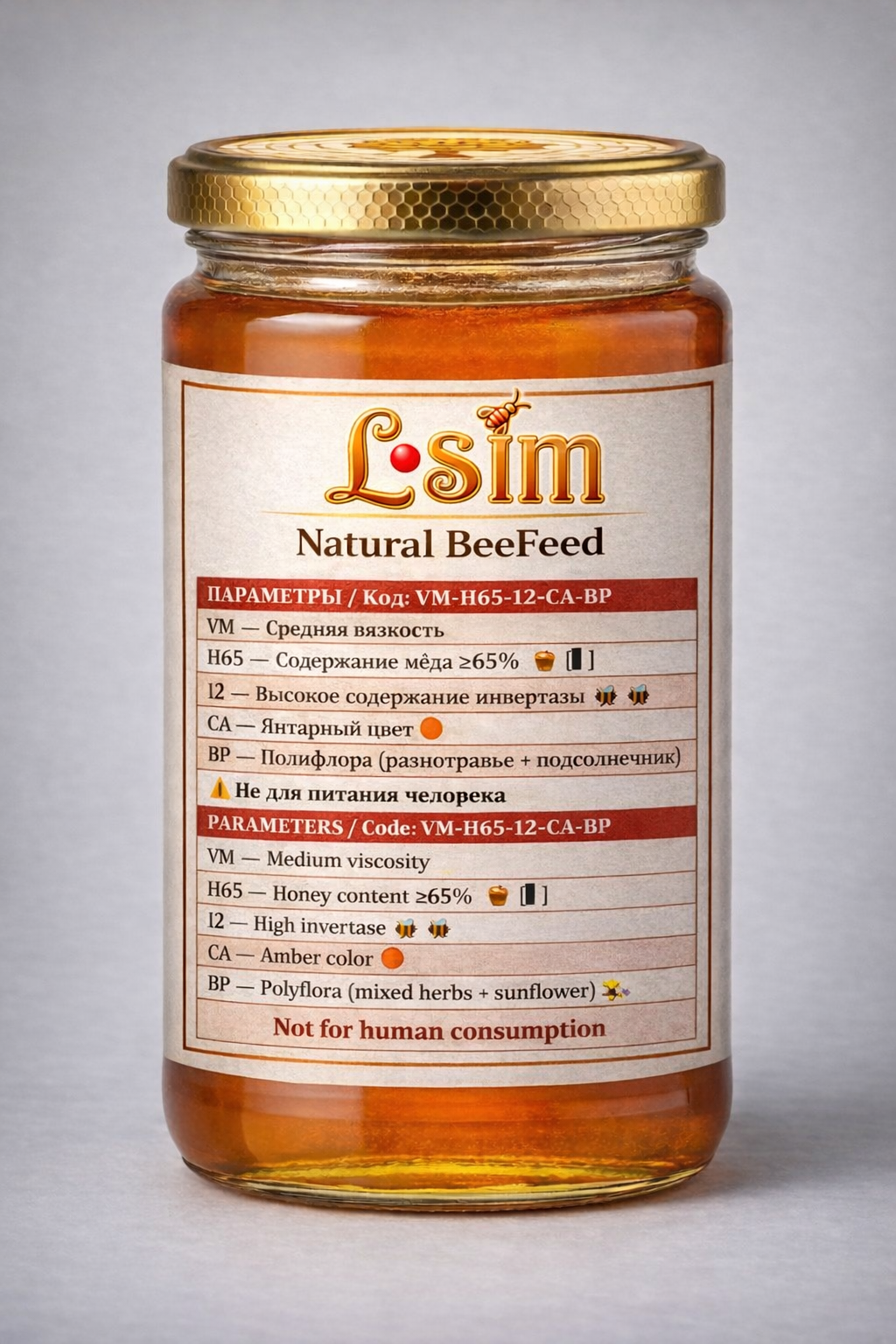
BeeFeed

Natural honey feed for supporting bee colonies during the off-season. Based on real honey, pollen enzymes and natural invertase. As close as possible to the bees\' natural diet.

Scroll
Key Features

What makes BeeFeed
exceptional

More than just feed — a complete honey-based foundation for the health of your bee colony in any season.

65%
Natural Honey Base
Every kilogram contains at least 65% natural honey, complemented by glucose and fructose. The composition closely mirrors nectar — bees accept the feed immediately.
≥65% Honey · H65
78%
High Dry Matter Content
Moisture of just 20% means bees don\'t need to evaporate excess water. Less energy spent, reduced wear, longer lives for worker bees and extended participation in honey production.
Moisture ≤20% · W20
I2
Natural Invertase
An enzyme that eases feed digestion and reduces the burden on bees. High invertase content is the key advantage over sugar and corn syrups.
High Invertase · I2
3
Varietal Options
Polyfloral, acacia, buckwheat — feed adapted to your region and apiary needs. Each variety preserves the aroma and nectar profile of the source honey.
Polyfloral · Acacia · Buckwheat
Absorption Rate
Compared to sugar syrups (sugar concentration up to 60%, moisture up to 40%), BeeFeed is absorbed significantly faster and requires no additional processing.
Easy Absorption
Summer & Off-Season
The range also includes liquid summer feeds — for stimulating activity, preventing swarming during dearth periods, and maintaining colony population.
Spring · Summer · Autumn
Comparison

BeeFeed vs.
conventional syrups

Sugar / Corn Syrups
Traditional Feed
  • Moisture up to 40% — bees spend energy on evaporation
  • Sugar concentration no more than 60%
  • No natural enzymes or invertase
  • Synthetic composition, far from nectar
  • Increased wear on worker bees
  • Risk of colony decline during off-season
Natural Honey Feed
Next-Generation Honey Base
  • Moisture ≤20% — zero energy spent on evaporation
  • ≥65% natural honey + glucose + fructose
  • Natural invertase for rapid absorption
  • Composition close to nectar — bees accept immediately
  • Worker bees live longer and are more productive
  • Colony strength maintained through spring and autumn
For the Beekeeper

Results you
can feel

🐝
Stable Colonies
Fewer losses during the off-season. Colonies retain their strength and numbers through spring and autumn.
🍯
More Marketable Honey
Bees participate in honey production longer — greater yield per colony.
🌿
Healthy Splits
Strong colonies are the foundation for creating quality splits and expanding the apiary.
100% Natural
No GMO, no chemicals.
Labelling System

Product Code

Every parameter is encoded in the product code — viscosity, composition, invertase, colour and varietal base.

V
Viscosity
VL — liquid
VM — medium
VHP — thick (paste)
H
Honey Content
H50 — ≥50%
H65 — ≥65%
H90 — ≥90%
I
Invertase
I0 — absent
I1 — present
I2 — high content
C
Colour
CL — light
CA — amber
CD — dark
B
Varietal Base
BP — polyfloral
BA — acacia
BB — buckwheat
W
Moisture
W20 — ≤20%
Code Example VM-H65-I2-CA-BP Medium viscosity · ≥65% honey · High invertase · Amber colour · Polyfloral (wildflower + sunflower)
Product Range

Varietal
options

Choosing a varietal base allows you to adapt the feed to your region and the preferences of your apiary.

Polyfloral
VM-H65-I2-CA-BP
Wildflower + sunflower. Amber colour, rich nectar profile. The universal choice for most regions. Medium viscosity, high invertase.
Acacia
VL-H65-I2-CL-BA
Light, almost transparent. Mild, neutral flavour — ideal for sensitive colonies. Liquid texture ensures easy application at any time of year.
Buckwheat
VM-H65-I2-CD-BB
Dark, rich. High in antioxidants and minerals. Especially effective for strengthening colonies in autumn — before winter. High biological value.
Storage Conditions

How to store
correctly

🌡️
Temperature –6…+40 °C. Below 0 °C the product hardens. At +20 °C and above it becomes more liquid. Above +40 °C it loses some of its beneficial properties.
💧
Humidity 55–65%, no more than 80%. Excess moisture may affect consistency and reduce shelf life.
🔒
Keep container tightly sealed. After each use, close the packaging securely to prevent contamination and moisture loss.
🥄
Dry utensils only. Use a clean, dry spoon or spatula. Water in the product can cause fermentation.
🌙
No direct sunlight. Store in a dark or shaded location. UV light destroys enzymes and reduces product quality.
📅
Shelf life — 12 months from the date of production. When stored correctly, the product retains all its properties throughout the entire shelf life.